If your agency is about to outsource CV formatting services, send the supplier a written brief with your template rules and acceptance criteria, and check every returned profile against the source CV before it counts as delivered. A rejected return costs you recruiter minutes on top of the quote. Then work out your break-even quote, the number you take into the negotiation: take what a month costs in-house with software (licence, set-up and recruiter time), subtract the recruiter time the service route still needs, and divide by your monthly client submissions. Below that number the service is cheaper; above it, doing it in-house with software is. If the supplier's standard return is next working day, the quote does not cover your same-day requests until you add its express price.
The brief to send a supplier
A formatting service applies your template to CVs it has never seen, for a client it has never met. Whatever you do not write down, it will decide for you. Send this with your request for a quote, and put it in the contract once you choose a supplier:
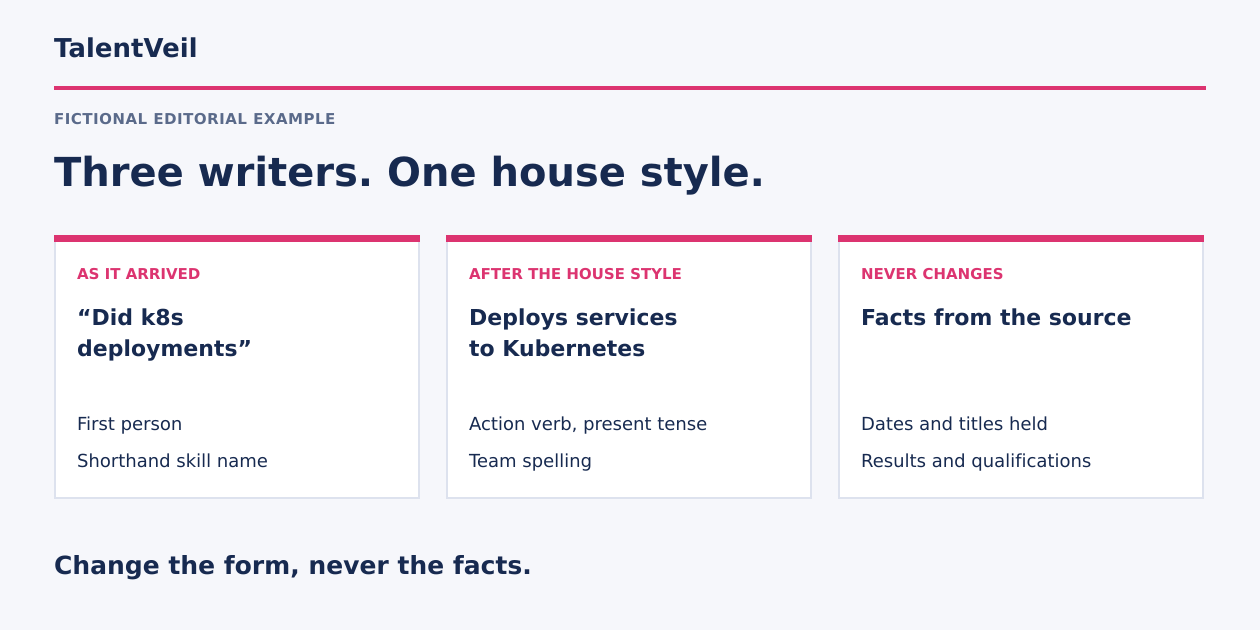
Use the attached agency template and the approved source CV only. Preserve role titles, dates and skill levels exactly as the candidate wrote them. Omit direct candidate contact details from every exported page, including headers and footers. Return the editable file and the requested final format. Flag anything ambiguous instead of filling it in. State which corrections are included, who resolves questions about the source CV, your turnaround to a profile that passes this brief, what a same-day return costs, and what a rejected or revised copy costs.
Three of those lines decide what the quote really costs:
- Express is part of the quote. If your standard return is next working day, ask what a same-day profile costs and put that figure in the comparison. A quote without it only covers the requests that can wait.
- A rejected copy has a price. Ask whether a profile that fails your brief is redone free, and how many times. Your recruiter's time spent sending it back is a cost either way.
- Someone owns questions about the source. A missing end date or an unclear job title needs an answer from the candidate, not a guess from the formatter. Agree who asks, and that the profile waits until the answer is in.
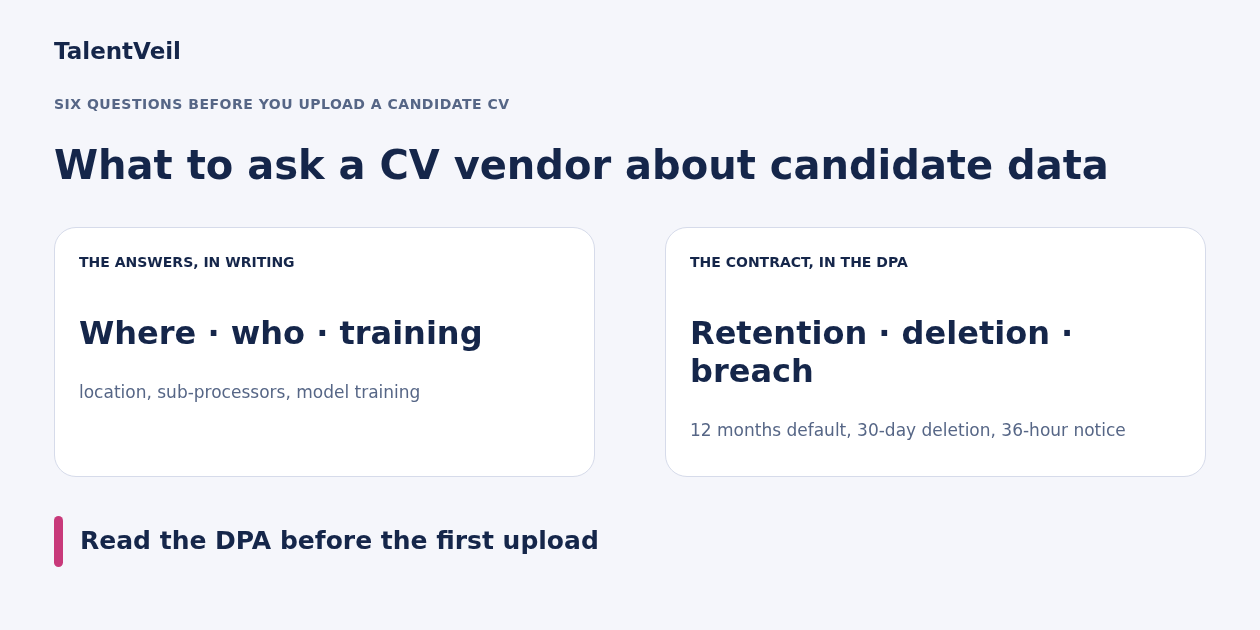
Ask the two questions you would ask any processor of candidate data, who can open the files and how soon after return they are deleted, and write both answers into the data processing agreement.
Check a returned profile before it counts as delivered
A profile that looks right can still fail the brief. Here is one example, with a fictional candidate.
The source CV and the request
- Role: Project coordinator, 2022–present
- Skill: Power BI, basic
- Footer: candidate-a@example.invalid
- Request: agency template; no direct contact; preserve the facts; do not infer seniority or skill level
What came back
Senior project manager | 2022–present | Advanced Power BI
The candidate's email address is still in the footer. The branding is perfect, and the profile fails on three counts: title, skill level and contact details.
What the recruiter corrects
- Title: the source says Project coordinator. Restore it; a formatter does not promote candidates.
- Skill level: the source says basic. The client wanting advanced Power BI is not evidence that the candidate has it.
- Footer: the direct contact is still on the page. Remove it, then check every exported page, not only the first.
- Dates: 2022–present is right; leave it. If the client needs to know the role is current, ask the candidate rather than adding an end date.
Accepted: "Project coordinator | 2022–present | Power BI, basic", with no direct contact anywhere in the file.
Every check like this takes recruiter minutes, on both routes: someone compares the profile with the source before a client sees it. What differs is what happens after a failure. With a supplier, the recruiter writes back, waits and checks the new version. In-house, the recruiter corrects the line in the editor. Count both in your comparison. For a fuller list of what to check line by line, use our guide to checking a candidate profile against the source CV.
Your break-even quote: a worked example
Suppose Agency A, an example agency with six recruiters, compares both routes over one month. Both routes get the same CVs, template and brief. All the numbers below are Agency A's own, not market rates.
Agency A's month
- 60 client submissions, 18 of them same-day requests
- Loaded recruiter cost: £30 an hour, so £0.50 a minute
Route 1: in-house with software (TalentVeil Team)
- Plan: £129 a month excluding VAT, for up to 100 profiles; Agency A used 60
- Template set-up by the operations lead: 180 minutes once, £90, spread over 12 months: £7.50 a month
- Recruiter time: 6 minutes per submission (upload, check every field against the source, adjust, export) = 360 minutes
- Corrections: 4 of 60 needed a fix in the editor, 5 minutes each = 20 minutes
- Labour: 380 minutes = £190.00
- Total: £326.50 a month, £5.44 per accepted submission
Route 2: outsourced service
- Quote: Q per CV, template set-up and one revision included, standard return next working day, express not quoted
- Recruiter time: 5 minutes per submission (1 minute to send with the brief, 4 minutes to check the returned file against the source) = 300 minutes
- Rejected returns: 6 of 60 failed the brief at first check, 10 minutes each to brief back and re-check = 60 minutes
- Labour: 360 minutes = £180.00
- Total: £180.00 + 60 × Q
The break-even quote
Q = (£326.50 − £180.00) ÷ 60 = £2.44 per CV, revisions included.
Agency A takes £2.44 into the negotiation, not £5.44: the service route still costs it £3.00 of recruiter time per CV, so a supplier's price has to fit in what is left.
What drives the number
- The licence, spread over your volume. Recruiter minutes favour the service here by only 20 minutes a month (£10). Almost all of the £2.44, about £2.15, is the licence divided by 60 submissions. Within a plan, the break-even falls as volume rises; it jumps when your volume needs the next plan.
- Checking time. At 60 submissions a month, every extra minute of checking per profile adds £30 a month to that route. A supplier whose returns need one more minute of checking costs as much as one quoting £0.50 more per CV.
- Deadlines. A next-working-day supplier cannot meet Agency A's 18 same-day requests. Unless express is quoted and added to Q, the comparison only holds for the 42 that could wait. Count how many of last month's same-day requests your own team actually met, and set that against the supplier's express price.
When the service is the better buy
A quiet month. Agency A sends 5 submissions, no software correction is needed, and one service return is rejected. On the service route the month costs 35 minutes of recruiter time (£17.50) plus 5 × Q; on the software route, 30 minutes (£15.00) plus set-up and licence.
- If Agency A stays on Team: software costs £15.00 + £7.50 + £129 = £151.50. Break-even Q = £26.80.
- If its quiet months are planned and it moves to Starter (£42 for up to 30 profiles; plan changes apply from the next billing period): software costs £64.50. Break-even Q = £9.40.
A small volume shares the licence between few CVs, so the per-CV quote a supplier has to beat is much higher. If most of your months look like this one, compare the supplier's quote with your quiet-month break-even, not with the busy-month figure.
Two more cases favour the service:
- It is a one-off clean-up: a backlog of profiles your team cannot absorb, after which the volume returns to normal.
- You are buying editorial judgement, not formatting: a written candidate report with commentary is a different deliverable, and should be priced as one.
Work out your own number
Use one month, one currency and the same CVs on both routes. Collect:
- Software: monthly plan price and how many profiles it includes; one-off template set-up (your minutes or a fee), divided by the months you will use it
- Service: the quote per CV; what revisions, express and extra formats cost; any set-up fee
- Recruiter minutes per submission, by route: sending or uploading, checking against the source, correcting or briefing back, final sign-off
- Failures: how many profiles failed the first check on each route, and the minutes each one cost
- Deadlines: how many requests were same-day, and which route met them
- Your loaded recruiter cost per hour
Then:
- Cost per route = fixed fees + set-up per month + per-CV charges + (active recruiter minutes ÷ 60 × hourly cost)
- Break-even quote = (software route cost − service route labour and fees) ÷ submissions in the month
Count only active minutes. Time spent waiting for a supplier is a deadline problem, not a labour cost.
Doing it in-house with TalentVeil
With TalentVeil's automated CV formatting, you upload the source CV and get an editable profile, blind or named, in your agency template. The recruiter checks it against the source, corrects any line in the editor and exports it to Word or PDF. Editing and downloading never count against your profiles. Then you share the shortlist in a branded client portal as one link: the client marks the candidates they want to meet and leaves feedback on each profile, and you are notified when they act.
Every plan includes every feature and unlimited users; you pay for the number of new CVs you upload each month (plans and prices). For more on which preparation steps are worth automating first, see how to save time by automating CV formatting.
Start free with 10 profiles, every feature included and no card needed. Run the CVs from your next shortlist through it and time each one from upload to export; those are the software-route minutes for your break-even quote.