
Before your agency sends a candidate profile to a client, compare each claim with the source CV and confirmed interview notes, correct any changes in meaning and keep unanswered questions open. This fictional worked case shows the full review: source material, an overstated summary, claim-by-claim corrections and a revised draft with outstanding questions recorded.
The candidate, employers and screening notes below are fictional. Use the example to check a client-submission draft against its source CV and confirmed notes.
The client request: a Finance Manager profile
A recruitment agency is preparing a candidate profile for a Finance Manager vacancy. The client asks about manufacturing reporting, budgeting, line-management scope, finance systems and availability.
The recruiter's job is to present the relevant evidence without turning the vacancy requirements into candidate credentials. Keep any recommendation separate from factual experience. There is no candidate score or automatic submission decision in this example.
For the overall layout, see our guide to creating a candidate profile for a client. Here, the task is narrower: deciding exactly which claims the supplied material supports.
Source A: the fictional source CV, version 1
January 2022–December 2024 — Management Accountant, Example Manufacturing A
Prepared monthly management reports and supported the annual budget. Coordinated reporting inputs from four budget holders. Used SAP for reporting.
April 2019–December 2021 — Assistant Accountant, Example Services B
Supported month-end reconciliations.
Qualification entry: “ACCA studies in progress.”
Skills entry: “Excel; SAP; introductory Power BI training.”
Availability: not stated.
Source B: separate screening interview note
The following note is confirmed with the fictional candidate. Keep it separate from the CV so a reviewer can see where the additional information came from.
- Worked in the reporting team, not as a line manager; the four budget holders were stakeholders, not direct reports.
- Used existing SAP reporting processes; did not lead an SAP implementation.
- Power BI training used practice data; no commercial Power BI project confirmed.
- One-month contractual notice period. Earliest start date for a new role has not been confirmed.
- Work history from January 2025 onwards and current ACCA study or completion status remain unconfirmed.
The note resolves some ambiguities but leaves others open. It does not make the CV's qualification entry current or establish employment after December 2024.
The deliberately flawed candidate summary
ACCA-qualified Finance Manager, with continuous manufacturing experience since 2019. Managed a four-person finance team and led an SAP implementation. Delivered Power BI dashboards commercially. Available to start in one month.
This summary reads smoothly, but it changes the candidate's qualification, title, sector history, management scope, systems experience and availability. The corrections below show what to retain, what to edit and what to ask rather than assume.
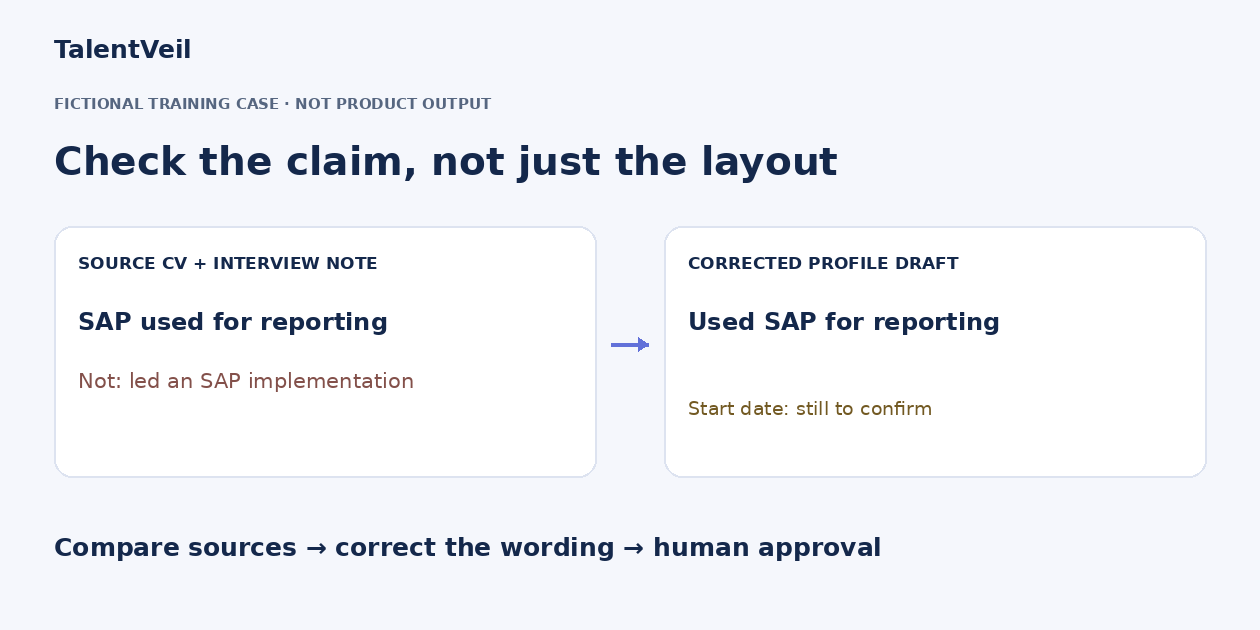
The completed source-to-profile review
Each numbered entry records the draft claim, the supplied evidence, the decision and the wording or question that follows. Pass against supplied source means the wording matches the material provided.
1. Qualification: remove “ACCA-qualified” and clarify current status
Claim in the draft: “ACCA-qualified”.
Evidence: Source A says “ACCA studies in progress.” Source B does not confirm completion and explicitly leaves the current qualification status unclarified.
Decision: Clarify. Remove the qualified claim. Neither completion nor membership can be inferred from a study entry.
Safe wording, if the entry needs to be referenced: “CV lists ACCA studies in progress.” This describes the document, not a confirmed current qualification status.
Question for the candidate: “What is your current ACCA study or completion status?”
Review outcome: Keep the qualification out of the corrected summary below pending clarification. Do not replace it with another qualification label.
2. Title and sector: use the roles and periods actually supplied
Claim in the draft: “Finance Manager…manufacturing experience since 2019”.
Evidence: Source A lists an Assistant Accountant role in services from April 2019 to December 2021, then a Management Accountant role in manufacturing from January 2022 to December 2024.
Decision: Edit. Applying for a Finance Manager vacancy does not establish that the candidate has held that title. The earlier services role cannot be counted as manufacturing experience.
Corrected wording: “Management Accountant in manufacturing, January 2022–December 2024; previously Assistant Accountant in services, April 2019–December 2021.”
Review outcome: Use the actual titles and periods. Keep the vacancy title in the client request, not as an unsupported candidate headline.
3. Continuity: remove the claim and leave the unanswered period visible internally
Claim in the draft: “continuous…since 2019”.
Evidence: Source A ends in December 2024. Source B leaves work history from January 2025 onwards unconfirmed.
Decision: Clarify. The material does not support continuous experience through to the present. It also does not establish unemployment.
Corrected wording: Retain the dated roles from entry 2, without “continuous”, “currently” or “to present”.
Question for the candidate: “What work have you been doing since January 2025?”
Review outcome: Record the unanswered period internally. Do not fill it with invented employment or quietly treat the older role as current.
4. Leadership: distinguish stakeholders from direct reports
Claim in the draft: “Managed a four-person finance team”.
Evidence: Source A says the candidate coordinated reporting inputs from four budget holders. Source B confirms that those people were stakeholders, not direct reports, and that the candidate worked in the reporting team rather than as a line manager.
Decision: Edit. Coordination is relevant to the client, but it is not evidence of line management.
Corrected wording: “Coordinated reporting inputs from four budget holders.”
Review outcome: Retain the coordination responsibility. Remove the team-management claim; do not use it to imply that the vacancy's line-management requirement has been met.
5. SAP: preserve reporting use without adding implementation ownership
Claim in the draft: “led an SAP implementation”.
Evidence: Source A says “Used SAP for reporting.” Source B confirms the use of existing reporting processes and states that the candidate did not lead an SAP implementation.
Decision: Edit. Using a system and leading its implementation are different responsibilities.
Corrected wording: “Used SAP for reporting.”
Review outcome: Keep reporting use. Remove implementation leadership rather than softening it to another unsupported implementation claim.
6. Power BI: keep training separate from commercial delivery
Claim in the draft: “Delivered Power BI dashboards commercially”.
Evidence: Source A lists introductory Power BI training. Source B says the training used practice data; no commercial Power BI project is confirmed.
Decision: Edit. Training does not establish commercial project delivery.
Corrected wording: “Introductory Power BI training.”
Review outcome: Retain the training at its stated level. Commercial project experience remains unconfirmed; do not present dashboards as a delivered client or employer outcome.
7. Availability: record the notice period, not a promised start date
Claim in the draft: “Available to start in one month”.
Evidence: Source A does not state availability. Source B confirms a one-month contractual notice period but not the earliest start date for a new role.
Decision: Clarify. A contractual notice period does not, by itself, establish when someone can start.
Internal wording: “One-month contractual notice period; start date to confirm.”
Question for the candidate: “What is your earliest confirmed start date for this role?”
Review outcome: Keep the notice-period information in the internal record. Do not promise a start date to the client or add the flawed availability statement to the corrected summary.
8. Reporting and budgeting: retain the supported scope
Information to carry into the profile: Monthly management reporting and support for the annual budget.
Evidence: Source A explicitly says the candidate prepared monthly management reports and supported the annual budget. Source B adds no conflicting statement.
Decision: Pass against supplied source. These responsibilities can remain with their scope unchanged.
Safe wording: “Prepared monthly management reports and supported the annual budget.”
Review outcome: Retain both responsibilities. Do not upgrade budget support to ownership of the annual budget.
The safe corrected summary — still a draft
Management Accountant in manufacturing from January 2022 to December 2024, following an Assistant Accountant role in services from April 2019 to December 2021. Prepared monthly management reports, supported the annual budget and coordinated reporting inputs from four budget holders. Used SAP for reporting; introductory Power BI training.
This version keeps the relevant reporting, budgeting and systems experience without adding qualifications, line management or implementation ownership. It does not answer every part of the client's brief, and it is not yet approved for submission.
If the recruiter adds a recommendation, keep it separate from this factual summary. For example, reporting and budget-support experience can explain why the profile is being considered; they cannot be used to imply confirmed line-management experience or a current qualification.
Unresolved items: the internal record stays open
The corrected prose does not close the review. These questions still need answers:
- Current work since January 2025: ask the candidate what they have been doing. Do not assert continuous or current employment.
- Current qualification status: ask about study or completion status before presenting any qualification label as current.
- Earliest start date: confirm it separately from the one-month contractual notice period.
Commercial Power BI project experience also remains unconfirmed. The summary therefore says only “introductory Power BI training”; it does not turn the absence of confirmation into a claim that the candidate has never used Power BI commercially.
Submission decision for this example: held for human review. A human reviewer must resolve the open items required for the submission and approve exactly what the client will receive. Keep open questions in the internal review record. Include uncertainty in the client-facing profile only where appropriate to the agreed submission; omitting an unresolved claim from the summary does not count as answering the question.
Copy each numbered entry's fields into your agency's internal review record: claim in draft / exact CV or confirmed-note evidence / Pass against source, Edit or Clarify / corrected wording or question / reviewer decision. Keep real candidate details in your agency's appropriate working environment, not in a public worksheet.
Format the profile, then share only after approval
Format the reviewed content in your agency template and export it as PDF or Word with TalentVeil's automated CV formatting for recruitment agencies.
After a human reviewer has resolved the required open items and approved the profile, share your shortlist in a branded client portal. The client can review profiles, mark who interests them and leave feedback.