
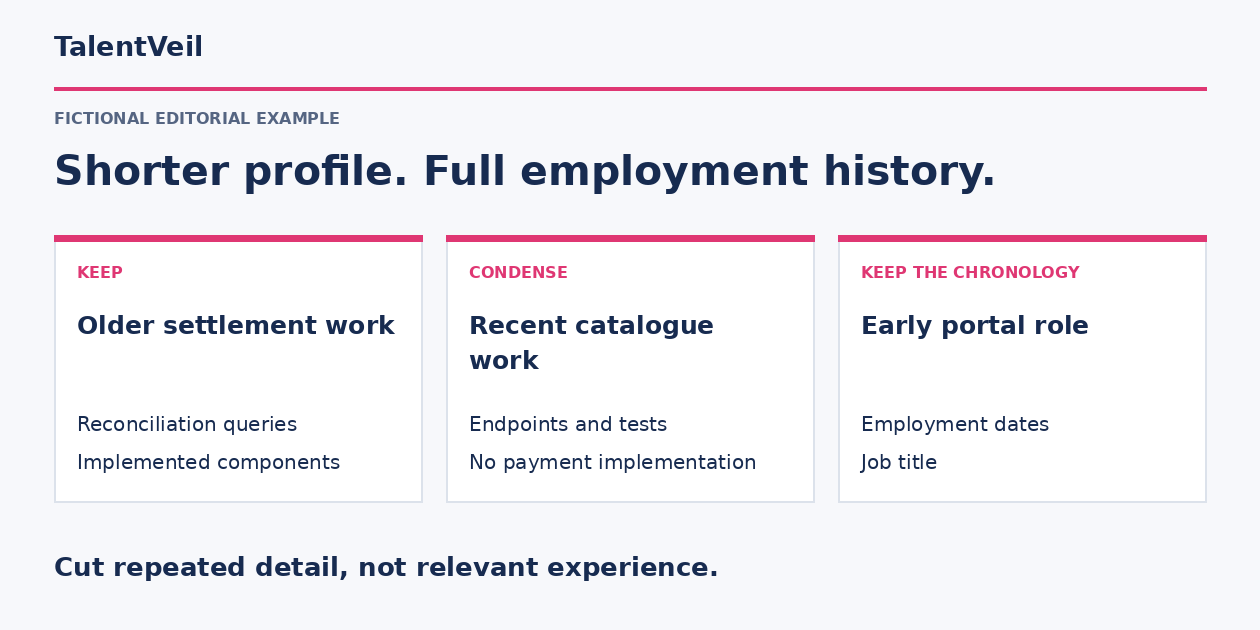
If you prepare consultant CVs for client submissions, keep the required fields and relevant project evidence, then cut repeated routine tasks and less relevant descriptions. The worked example below takes you from a full source profile to a shorter client version, retaining every employment period and held title.
For a recruiter or IT-staffing account manager, the difficult decision is often which project deserves detail. An older assignment may answer the request better than the latest one. Here is a complete source profile, the editing decisions and the shorter client version.
1. Start with the client's limits, not the font size
Fictional worked example: all employers, qualifications, project facts and client requirements below are invented. The profiles are editorial examples, not TalentVeil-generated output.
The client requests a backend engineer for a payments API team, with evidence of personal Java, Spring and PostgreSQL work, including reconciliation experience.
For this submission, the client specifies:
- A PDF of no more than two pages, using its existing font size, margins and section order.
- A summary of no more than 60 words.
- No more than two detailed projects, each with a description of no more than 80 words.
- No more than eight skills.
- A profile identifier, every employment period and held title, selected project dates, roles, personal tasks and technologies, education and availability.
Two pages is this client's requirement, not a general rule for consultant CVs. Word limits help you edit the content; pagination still needs checking in the actual template.
Keep a full master profile and make a separate client version. Consulting LIFE's guide to consultant profiles describes using a central base document to prepare project-specific profiles. Europass's CV guidance also separates a full record of experience and qualifications from the information selected for an individual CV.
2. The full source profile
F-17 — Backend engineer
Summary
Backend engineer who has worked on commerce, payment reporting and internal-service applications. Builds and maintains Java services, discusses API changes with other developers, writes automated tests and investigates reported defects. Experience includes Spring Boot, PostgreSQL, REST endpoints and Git-based review. Has also worked with MySQL and basic JavaScript. Enjoys learning new technologies and working in collaborative teams. Has taken introductory AWS training. Looking for an engineering project with an opportunity to develop technical skills. Has participated in regular team ceremonies, planning meetings, backlog refinement and retrospective discussions. Values clear documentation and reliable delivery.
Employment history
- 01/2025–10/2026 — Backend Engineer, Example Commerce A.
- 01/2022–12/2024 — Software Engineer, Example Payments B.
- 07/2019–12/2021 — Junior Software Engineer, Example Services C.
Project: Commerce catalogue services
Employer: Example Commerce A
Dates: 01/2025–10/2026
Role: Backend Engineer
Technologies: Java, Spring Boot, PostgreSQL, REST, JUnit, Git.
Implemented REST endpoints for product catalogue updates in Java and Spring Boot. Added PostgreSQL queries and indexes for the catalogue service. Wrote JUnit tests for validation rules and regression cases. Investigated defects reported by the support team and documented the changes. Participated in code review with the other backend developers. Worked with frontend colleagues to agree request and response fields. Joined planning, daily updates and retrospective meetings. The wider project included checkout and payment integrations, but this engineer's assigned scope was the catalogue service. Did not implement payment processing or settlement reconciliation on this project. Maintained internal endpoint documentation and recorded test cases. Helped clarify tickets with the product owner. Used Git for pull requests and reviewed feedback before merging changes. Attended an internal workshop about the company's deployment setup.
Project: Settlement reporting service
Employer: Example Payments B
Dates: 01/2022–12/2024
Role: Software Engineer
Technologies: Java, Spring Boot, PostgreSQL, REST, JUnit, Git.
Implemented Java and Spring Boot endpoints used by an internal settlement reporting service. Wrote PostgreSQL reconciliation queries comparing transaction records with settlement files. Investigated mismatched records with operations colleagues and added regression tests after agreed fixes. Documented the endpoint fields and reconciliation exceptions. Participated in review of changes with senior engineers. The engineer implemented assigned components; a separate architect owned the service design. A separate operations team owned live settlement processing and deployment. Joined refinement, planning and daily meetings. Maintained ticket notes, updated internal documentation and presented completed changes in team reviews. Used Git pull requests and JUnit tests. Followed the team's existing branching conventions and release checklist. Helped colleagues reproduce data discrepancies with test fixtures. No budget ownership, people management or architecture ownership is stated in this source.
Project: Internal service portal
Employer: Example Services C
Dates: 07/2019–12/2021
Role: Junior Software Engineer
Technologies: Java, MySQL, JavaScript, Git.
Maintained Java code for an internal service-request portal. Fixed form-validation defects and updated basic JavaScript behaviours in the browser. Wrote MySQL queries supporting internal reports. Worked from tickets prepared by a senior developer and asked for review before changes were merged. Updated the support team's instructions after changes to the request forms. Attended daily team meetings and took notes during planning. Helped test bug fixes using sample requests. Used Git for source control and the team's ticketing system for progress updates. No payments or settlement work is described for this project.
Skills, education and availability
Skills: Java, Spring Boot, PostgreSQL, REST, JUnit, Git, MySQL, JavaScript, HTML, CSS, Jira, Confluence, Scrum ceremonies, introductory AWS training.
Education: BSc Computer Science, Example University, 2019.
Training: Introductory AWS course, 2024. No AWS certification stated.
Languages: Polish native; English B2 (self-reported).
Availability: Earliest start date not confirmed.
3. What stays, what gets shorter and what comes out
Keep the older settlement project in detail
The settlement reporting assignment earns one of the two project slots because it contains the reconciliation work the client asked to see: PostgreSQL queries comparing transactions with settlement files, investigation of mismatches and regression tests.
Keep the distinction between implementing components and owning the service. The separate architect's design responsibility and the operations team's responsibility for live settlement processing and deployment do not become the engineer's achievements just because the description is shorter. Nor does the source establish budget ownership or people management.
The revised description drops meeting attendance, ticket notes and repeated documentation detail. It keeps the work the client can ask about in a technical discussion.
Keep the recent commerce project, but cut routine detail
The commerce assignment provides recent evidence of Java, Spring Boot and PostgreSQL implementation. Keep the endpoints, queries, indexes, tests and collaboration over API fields.
Remove the list of ceremonies, pull-request steps and the internal deployment workshop. Those details use space without adding much to this particular request. Do not replace them with “payments API development”: the wider project's payment integrations were outside this engineer's catalogue-service scope. That boundary stays visible in the shorter version.
Reduce the portal project to employment chronology
The early portal work remains in the master profile. Its form validation, basic JavaScript and MySQL reporting do not displace either retained project for this request. Remove the detailed project entry, but retain Example Services C, Junior Software Engineer and 07/2019–12/2021, with a short note identifying the internal Java portal work.
This is a choice about limited space, not a finding that the consultant lacks other experience. Keeping the early role also avoids making the career appear to start in 2022.
Select six skills and remove the generic introduction
Use Java, Spring Boot, PostgreSQL, REST, JUnit and Git. Each appears in the retained projects. Eight is a maximum, not a target: there is no need to add MySQL or JavaScript simply to fill the allowance. HTML, CSS, Jira, Confluence and Scrum ceremonies also come out of this version.
Replace the source summary's learning preferences, general teamwork statements and meeting attendance with a short account of the retained experience. Omit the introductory AWS course from this submission: the client did not request it, and the course does not establish certification or production AWS responsibility. Its exact wording remains in the master profile.
Education stays. So do all held titles and employment dates. Availability stays unresolved rather than becoming an invented start date.
4. The complete shortened consultant profile
F-17 — Backend engineer
Summary
Backend engineer with Java, Spring Boot and PostgreSQL work on commerce catalogue and settlement reporting services. Implemented reconciliation queries in the settlement project; recent commerce work covered catalogue APIs, not payment processing. Personal scope was implementation, not architecture ownership.
Selected skills
Java · Spring Boot · PostgreSQL · REST · JUnit · Git
Selected project: Commerce catalogue services
Employer: Example Commerce A
Dates: 01/2025–10/2026
Role: Backend Engineer
Implemented catalogue REST endpoints, PostgreSQL queries and indexes, plus JUnit regression tests. Agreed API fields with frontend colleagues and investigated support defects. Scope was the catalogue service, not the wider project's payment processing or settlement reconciliation.
Technologies: Java, Spring Boot, PostgreSQL, REST, JUnit, Git.
Selected project: Settlement reporting service
Employer: Example Payments B
Dates: 01/2022–12/2024
Role: Software Engineer
Implemented Java/Spring Boot endpoints and PostgreSQL reconciliation queries comparing transaction records with settlement files. Investigated mismatches with operations and added regression tests. Implemented assigned components; a separate architect owned service design. A separate operations team owned live settlement processing and deployment.
Technologies: Java, Spring Boot, PostgreSQL, REST, JUnit, Git.
Employment history
- 01/2025–10/2026 — Backend Engineer, Example Commerce A.
- 01/2022–12/2024 — Software Engineer, Example Payments B.
- 07/2019–12/2021 — Junior Software Engineer, Example Services C; internal Java service portal.
Education
BSc Computer Science, Example University, 2019.
Languages
Polish native; English B2 (self-reported).
Availability
Earliest start date not confirmed.
5. Check the exported PDF before sending
Put the shorter profile into the client's unchanged template and open the exported PDF. Check the actual page count, readable text and section breaks. A shorter text does not establish that the PDF fits two pages.
If it overflows, remove another low-value phrase or repeated description. Do not shrink the font or margins, drop an employment period or remove the responsibility boundaries to make it fit. If the required information still cannot fit legibly, ask the client which constraint can change.
Compare the final version with the source for dates, titles and personal scope. The two detailed projects should still distinguish catalogue work from reconciliation work, and implementation from architecture, live settlement operations and deployment. The full employment chronology and education must remain present.
Availability is the outstanding question in this example. Confirm the earliest start date with the consultant before sending the submission; an end date on the last role does not establish immediate availability.
From selected content to the client template
Choosing which evidence to retain is an editorial decision. Formatting is the next step: applying the company or client template, checking the content and reviewing the export. Our guide to consultant CV formatting software covers that separate workflow.
TalentVeil turns source CVs into editable branded or blind profiles, applies templates and exports PDF or Word. Once your team has reviewed the profiles, share the shortlist in a branded client portal and see who your client likes: the client can mark interest and leave feedback on each profile.
For recurring client submissions, explore automated CV formatting for recruitment agencies to put your selected content into a consistent template.