
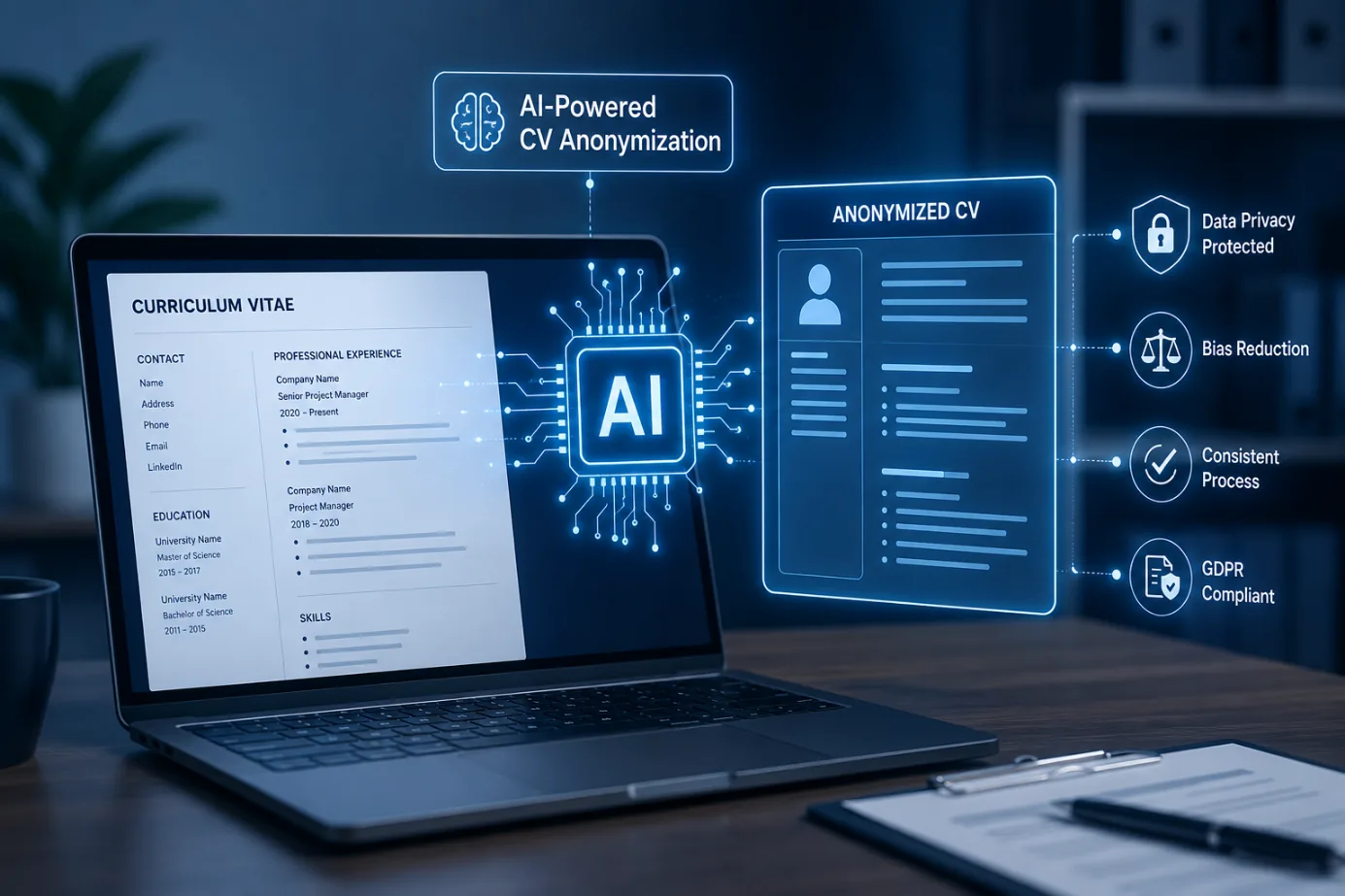
AI Is Changing How Recruiters Handle Candidate Data
Many recruiters are experimenting with tools such as ChatGPT, Claude, Gemini, and Microsoft Copilot to remove personal information from CVs before sharing them with hiring managers.
At first glance, this seems like an effective way to support blind hiring. AI can quickly identify names, contact details, and other obvious personal information, reducing the amount of manual work required during candidate screening.
However, blind hiring is not simply about removing a few lines from a document.
To reduce bias effectively, organizations need a consistent and repeatable anonymization process that preserves candidate qualifications while removing information that could influence hiring decisions. This requires more than a generic AI prompt.
The challenge is not AI itself. The challenge is relying on tools that were not designed specifically for recruitment workflows.
What Is Blind Hiring and Why Does CV Anonymization Matter?
Blind hiring is a recruitment approach that removes identifying information from candidate applications before they are reviewed.
The goal is to help hiring teams focus on skills, experience, and qualifications rather than personal characteristics that may introduce unconscious bias.
Depending on the organization's hiring process, anonymization may involve removing:
- Names
- Photos
- Email addresses
- Phone numbers
- Home addresses
- Social media profiles
- Nationality information
- Graduation dates
- Other identifying details
When implemented consistently, blind hiring can support fairer and more objective hiring decisions.
As a result, more organizations are adopting CV anonymization as part of their recruitment strategy.
Generic AI Tools May Not Follow Consistent Anonymization Standards
General-purpose AI assistants are designed to answer questions, generate content, and assist with a wide range of tasks.
They are not specifically designed to apply standardized recruitment policies.
This can create challenges when anonymizing candidate CVs.
For example, one CV may have a LinkedIn profile removed while another similar application may not. Certain demographic indicators may be removed from one document but remain visible in another.
Blind hiring depends on consistency.
Organizations need confidence that anonymization rules are applied in the same way across all candidate applications. Without predefined standards, it becomes difficult to ensure fairness and repeatability throughout the recruitment process.
Candidate Privacy and Compliance Still Matter
Candidate CVs contain personal data.
Organizations that use technology to process applications should understand how candidate information is handled throughout the recruitment process.
Questions such as the following are increasingly important:
- Where is candidate data processed?
- Who can access it?
- How long is information retained?
- Does the process align with internal privacy policies?
- Can the organization demonstrate accountability if required?
These considerations apply regardless of whether the anonymization process is manual, AI-assisted, or fully automated.
For many HR teams, privacy, governance, and compliance requirements are becoming essential parts of recruitment technology decisions.
Blind Hiring Requires More Than Simple Data Removal
Removing names and email addresses is only one part of effective CV anonymization.
A successful blind hiring process should:
- Apply consistent anonymization standards
- Preserve candidate qualifications and achievements
- Reduce opportunities for bias
- Support transparency and accountability
- Integrate with recruitment workflows
This is why many organizations choose dedicated candidate anonymization solutions rather than relying solely on general-purpose AI assistants.
The goal is not to avoid AI. The goal is to use AI within a structured process designed specifically for recruitment.
How Talent Veil Supports Consistent Candidate Anonymization
Talent Veil was built specifically for organizations that want to implement blind hiring without relying on manual editing or generic AI prompts.
The platform combines AI-powered CV anonymization with predefined recruitment workflows, helping ensure that anonymization standards are applied consistently across all candidate applications.
Rather than simply removing names and contact details, Talent Veil is designed to support objective candidate evaluation by reducing identifying information while preserving the skills, experience, and qualifications that matter for hiring decisions.
This allows recruitment teams to scale blind hiring initiatives while maintaining consistency, transparency, and control throughout the screening process.
Built for Europe. Ready for Your Legal Team.
For many organizations, candidate anonymization is not only a recruitment challenge but also a privacy and compliance consideration.
Unlike general-purpose AI tools, Talent Veil was designed with European organizations and enterprise requirements in mind.
Key capabilities include:
- Data processing and storage within the European Economic Area (EEA)
- Self-hosted AI infrastructure, ensuring candidate data remains within Talent Veil-controlled environments
- Data Processing Agreements (DPA) available for legal and procurement teams
- Audit-ready documentation to support security, privacy, and compliance reviews
These features help organizations evaluate and adopt blind hiring workflows with greater confidence, while simplifying discussions with legal, compliance, and information security teams.
For companies operating in regulated industries or handling large volumes of candidate data, privacy and governance are often just as important as automation. Talent Veil is designed to support both.
Final Thoughts
AI is becoming an important part of modern recruitment, and automation can significantly improve efficiency across hiring processes.
However, blind hiring requires more than simply asking a general-purpose AI assistant to remove personal information from a CV.
Effective candidate anonymization depends on consistency, transparency, and recruitment-specific workflows. Organizations that want to reduce bias while maintaining control over candidate data should ensure that their anonymization process is built for the realities of modern hiring.
When it comes to blind hiring, the difference is not whether AI is used. It is how that AI is applied.
Learn how Talent Veil helps organizations implement blind hiring while maintaining privacy, consistency, and compliance.