
What Is CV Anonymization?
CV anonymization is the process of removing personal or identifying information from resumes before recruiters review them. The goal is to ensure candidates are evaluated based on their professional qualifications rather than background-related signals that may introduce bias.
An anonymized CV typically removes:
- name and surname
- gender indicators
- age or date of birth
- photos
- address or location
- graduation dates
- nationality or marital status
Instead, recruiters focus on work experience, skills and competencies, certifications, achievements and results, and role relevance. This approach is commonly associated with blind recruitment, blind hiring, and anonymized candidate screening.
Why CV Anonymization Matters in Recruitment
Hiring bias is often unintentional. Even experienced recruiters can be influenced by information unrelated to job performance. Research consistently shows that names, age, gender, and educational background may affect hiring decisions without conscious awareness.
CV anonymization reduces these risks by standardizing the early screening stage. Key benefits include:
- more objective candidate evaluation
- improved diversity outcomes
- fairer shortlisting
- more consistent hiring decisions
- stronger compliance with equality policies
For many organizations, anonymized recruitment is becoming a core part of modern talent acquisition strategy.
How CV Anonymization Works
The anonymization process can be done manually or automatically.
Manual anonymization involves recruiters manually editing resumes: opening the CV, removing personal information, saving a new anonymized version, and sharing it internally. While possible, this approach creates significant operational problems: time-consuming workflows, inconsistent anonymization, higher risk of human error, and difficulty scaling recruitment operations.
Automated CV anonymization uses modern software to detect personal data automatically, remove identifying details instantly, standardize CV formatting, assign anonymous candidate IDs, and generate structured candidate profiles. This makes anonymized recruitment significantly faster and more scalable. You can test how this works for free on TalentVeil.
What Information Should Be Removed From a CV?
The purpose of anonymization is not to remove all context, but only the information that may introduce bias.
Commonly removed:
- full name
- profile photos
- gender identifiers
- exact address
- date of birth
- graduation years
- nationality
- marital status
Usually retained:
- work history and job titles
- skills and certifications
- project outcomes
- measurable achievements
Effective anonymization preserves evaluation quality while reducing bias.
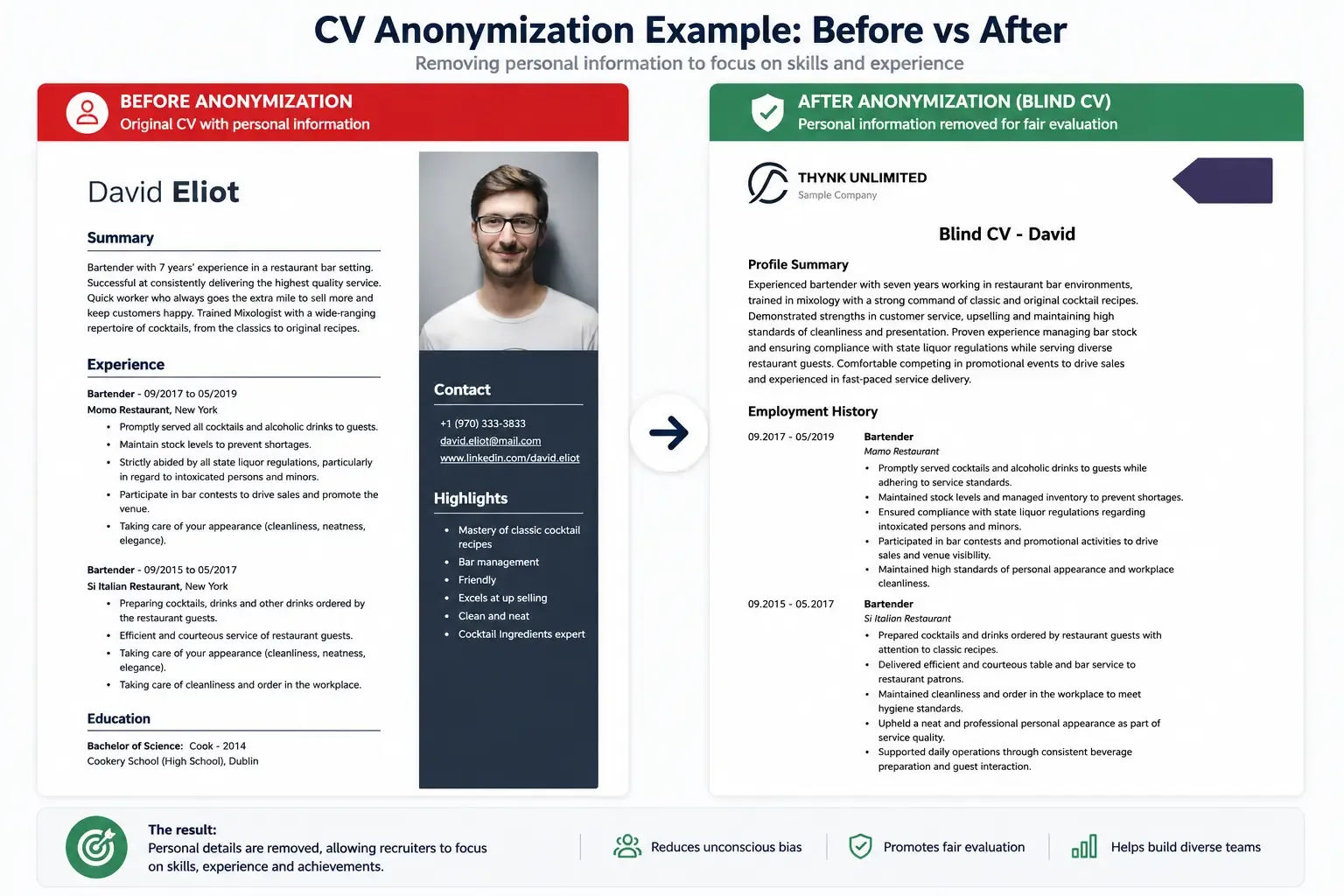
CV Anonymization Example
One common misconception is that anonymized resumes provide less clarity. In reality, they often improve focus and comparability.
Before anonymization: David Eliot · New York, USA · Photo visible · Phone, email, LinkedIn included · Bartender with 7 years of restaurant experience
After anonymization: Candidate David · Bartender / Mixologist · 7 years of hospitality experience · Strong customer service and upselling skills · Personal information removed for objective evaluation
The anonymized version shifts attention toward performance and relevance rather than personal background.
Benefits of Anonymized Recruitment
Reduced hiring bias. Removing identity-related information helps recruiters evaluate candidates more objectively.
Better diversity and inclusion. Blind recruitment processes often improve representation across shortlists and interview pipelines.
Faster screening at scale. With automation, large recruitment teams can anonymize thousands of CVs efficiently.
More structured evaluation. Standardized candidate profiles make comparisons more consistent across applicants.
Improved employer reputation. Fair hiring practices strengthen employer branding and candidate trust.
Challenges of CV Anonymization
Although anonymized recruitment offers major advantages, implementation can create challenges.
Over-anonymization. Removing too much information may reduce useful context for recruiters.
Manual workflows. Without automation, anonymization becomes operationally inefficient.
Bias later in the process. Blind CVs reduce bias during screening, but interviews and assessments also need structure to maintain fairness throughout the hiring pipeline.
When Companies Should Use CV Anonymization
CV anonymization is especially useful when:
- application volume is high
- recruiters need standardized evaluation
- diversity goals are important
- compliance and transparency matter
- hiring bias has become a measurable concern
Industries with large-scale recruitment — staffing agencies, tech companies, public sector hiring — often benefit the most from automated anonymization workflows.
The Future of Anonymous Recruitment
CV anonymization is part of a broader shift toward data-driven hiring. Modern recruitment increasingly includes structured candidate evaluation, AI-assisted screening, standardized scoring systems, and anonymized recruitment pipelines.
As hiring becomes more scalable and technology-driven, anonymization tools are becoming part of standard recruitment infrastructure rather than a niche practice.
Why Manual CV Anonymization No Longer Scales
Recruitment teams relying on manual editing face growing operational limitations: slower hiring cycles, inconsistent anonymization quality, higher administrative workload, and increased compliance risk. Automation solves these issues by enabling fast and consistent anonymization across large candidate pools.
Platforms like TalentVeil help organizations transform resumes into structured, anonymized candidate profiles instantly — without slowing down hiring or adding to the team's workload.