
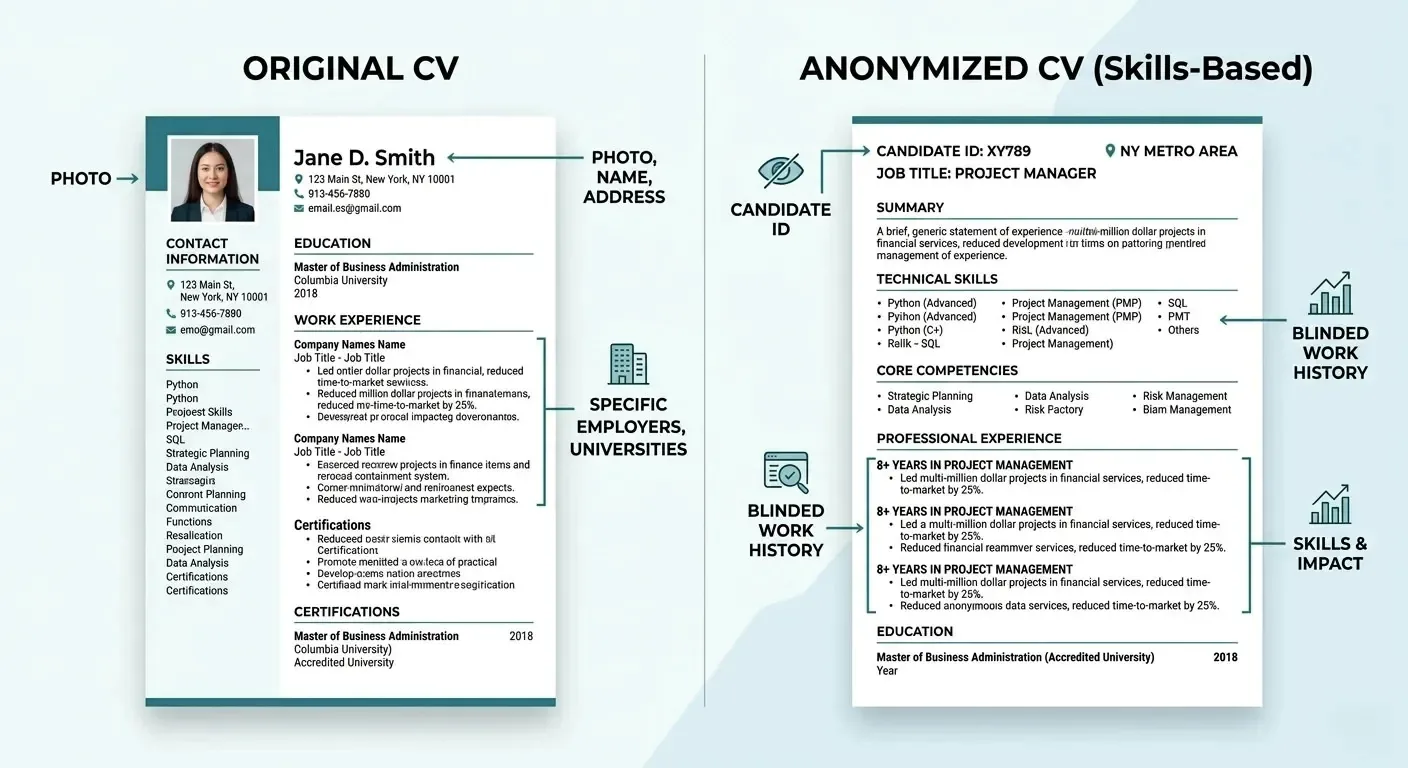
What Is a Blind CV and Why It Matters
Hiring decisions are often made in under 10 seconds. In that short time, details like a candidate's name, age, or background can influence outcomes — often without conscious intent.
A blind CV is a version of a resume that has been stripped of identifying details so recruiters can evaluate candidates based only on relevant qualifications. Often referred to as an anonymised CV, it removes signals that can unintentionally influence decisions, including:
- name and surname
- gender indicators
- age or graduation dates
- location and address
- photos
Instead, the focus shifts to professional experience, skills and competencies, and measurable achievements. The purpose is not to hide useful information, but to remove what should not affect hiring decisions.
Blind CV Example: Before and After Anonymisation
A common concern is that anonymisation reduces clarity. In practice, it often improves it.
Before (standard CV): Anna Kowalska · Warsaw, Poland · University of Warsaw (2015–2019) · 4 years in SaaS sales
After (blind CV): Candidate #4821 · B2B SaaS sales specialist · 4 years experience in mid-market pipeline generation · Closed €1.2M ARR in 2024
By removing identity-related data, the anonymised CV highlights performance and relevance more clearly.
What Is a CV Blinder and How It Works
A CV blinder is a tool that automatically converts standard resumes into anonymised CVs. Instead of manually editing documents, it:
- detects and removes personal data
- replaces identifying information with neutral labels
- standardises CV structure
- assigns candidate IDs
This allows recruiters to review applications consistently and at scale. You can see how this works in practice on TalentVeil — where you can try CV anonymisation for free.
How to Anonymise a CV: Manual vs Automated Approach
Manual anonymisation typically involves opening the CV, removing personal details, replacing identifiers, and saving a new version. This creates several issues:
- time-consuming (minutes per CV)
- inconsistent results across team members
- risk of missing sensitive data
- difficult to scale
Using a CV blinder transforms the process: upload the CV, the system anonymises it automatically, and recruiters review a structured profile. Key benefits include speed and efficiency, consistent anonymisation, scalability, and better compliance.
Why Blind CV Screening Improves Hiring Outcomes
More objective evaluation. Removing personal context helps recruiters focus on skills, experience, and measurable results.
Improved diversity outcomes. Using anonymised CVs often leads to more balanced shortlists and reduces early-stage bias.
Better decision quality. Candidates are assessed based on performance rather than background signals, making hiring decisions more consistent.
Stronger compliance and transparency. In the EU and other regulated markets, anonymised CV workflows support fair hiring practices and provide a clear audit trail.
When to Use a Blind CV Strategy
A blind CV approach is especially useful when:
- you receive a high volume of applications
- consistency in screening is important
- diversity and fairness are priorities
- your hiring process needs to be transparent and auditable
Common Mistakes When Using Anonymised CVs
Removing too much information. Over-anonymisation can make evaluation harder. The key is to remove identity data while keeping performance context.
Relying on manual processes. Manual anonymisation slows down hiring and introduces inconsistency. Automation is more effective at scale.
Treating blind CVs as a complete solution. Blind CVs reduce bias at the screening stage, but structured interviews are still necessary to maintain objectivity throughout the process.
The Future of Anonymised Hiring
Blind CVs are part of a broader shift toward structured, data-driven recruitment. This includes anonymised hiring pipelines, AI-supported evaluation, and standardised scoring systems. In this context, tools like a CV blinder become a core part of recruitment infrastructure rather than an optional add-on.
Modern recruitment requires automation to remain efficient and competitive. Platforms like TalentVeil help convert resumes into structured, anonymised profiles instantly — making it practical for teams of any size to implement blind hiring at scale.